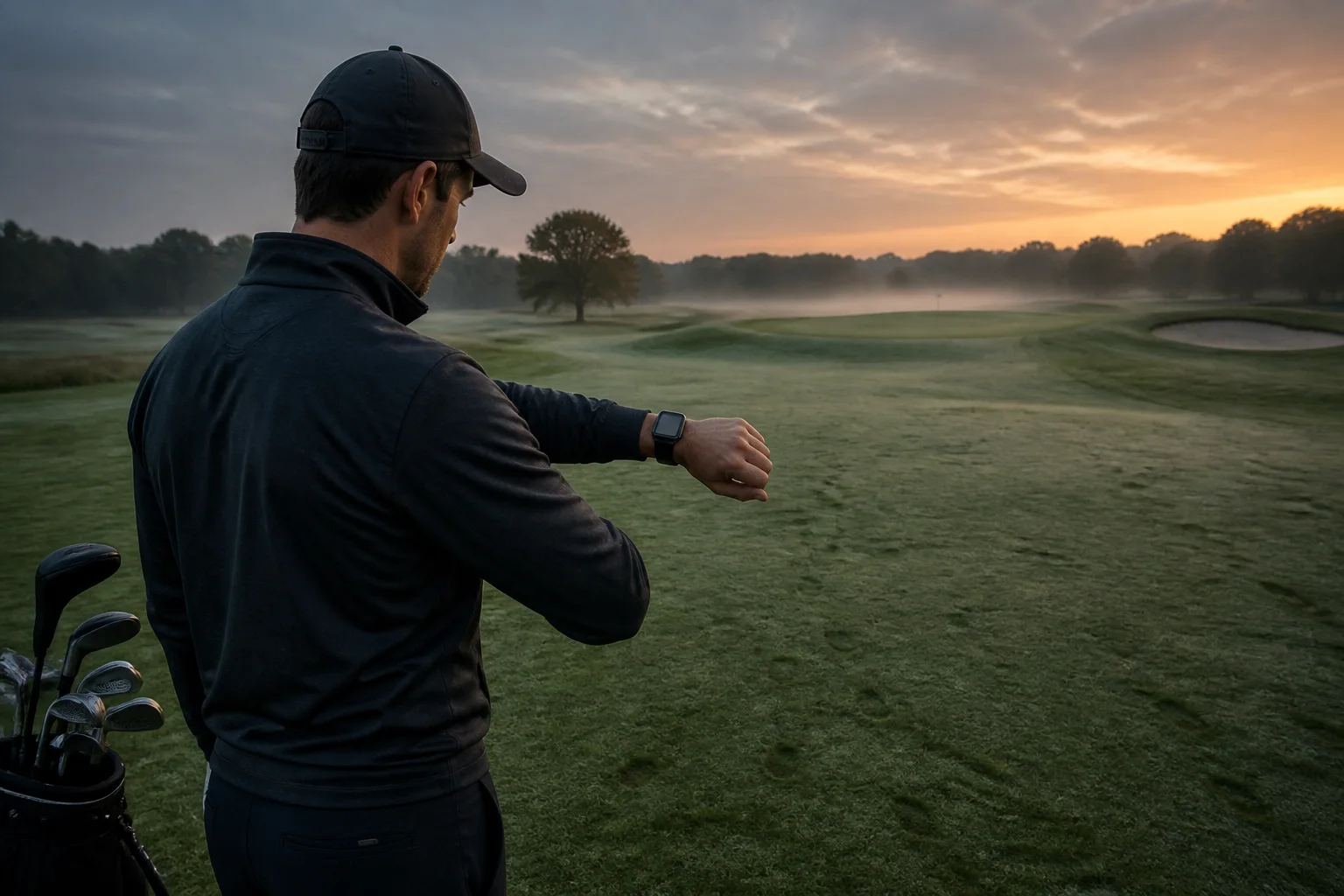
Choose CNDR if you want the software to build a complete, personalized course plan and connect it to automatic Apple Watch shot tracking for $79.99 a year. Choose DECADE if you mainly want Scott Fawcett’s established course-management curriculum, mental-game teaching, live instruction, printable yardage books and its accompanying planning and statistics tools.
Golfers are often told to play smarter. This sounds useful until they reach a 410-yard par four with water left, rough right and a driver pattern wide enough to visit both.
“Play smart” is not a decision. A decision has a club and an aim point. It takes the ugly shots seriously. Most of all, it can be tested after the round.
This is the ground CNDR and DECADE share. Both reject the idea that strategy is simply firing at flags with better self-control. Both start from shot patterns, hazards and expected outcomes. But they turn that idea into different products.
CNDR vs DECADE Golf at a glance
| Feature | CNDR | DECADE Golf |
|---|---|---|
| Core product | Apple Watch-native planning, automatic tracking, practice and performance platform | Course-management education system with planning, statistics and practice tools |
| Personalized target planning | Yes—complete hole-by-hole plans across the course | Yes—optimal target framework and Driving Targets software |
| Planning inputs | Every mapped club, personal distances, dispersion, tee and approach shape, terrain, hazards, landing width and penalty risk | Shot distribution, scoring expectations, distance, hazards and hole location; Driving Targets accepts driver distance and dispersion width |
| Plan output | Club, aim point, landing area, distance travelled, distance remaining, expected strokes, rationale and aggressive alternative | Target-selection guidance, driving targets, education and printable yardage books |
| Manual plan editing | Yes—move targets, change clubs, inspect dispersion and save the playbook | Yes—plot tee strategy and prepare with yardage books |
| Automatic shot tracking | Yes—swings and putts detected through Apple Watch motion models, with GPS locations | Offers quick DECADE5 entry or full GPS-style stats entry; automatic watch-based detection is not its core workflow |
| Strokes gained | Yes—off the tee, approach, around the green and putting | Yes—advanced stats tracking, with plan-dependent benchmark detail |
| Practice | Apple Watch swing motion plus dispersion and distance views | Structured combines, putting work and practice curriculum |
| Mental-game curriculum | Not a primary product layer | Yes—a major part of Foundations and Elite training |
| Yardage books | Saved digital course plans | Printable books from a database of 40,000+ courses |
| Availability | Early access | Established product |
| Published US price* | $79.99/year | Breaking 90: $89/6 months; Foundations: $125/6 months or $199/year; Elite: $250/6 months or $325/year |
*Pricing checked August 20, 2026. Offers, renewals and regional prices can change.
They agree on the part most golfers get wrong
A shot is not its average. A player who carries driver 260 yards does not hit a point 260 yards away. He produces a cloud of possible outcomes. The target should be chosen for the cloud.
DECADE was built on this insight. Its own description says the system combines shot-distribution patterns with scoring statistics to optimize target selection. Distance, hazards and hole location determine how far the aim point should move from trouble.
CNDR begins in the same statistical neighborhood. It overlays the golfer’s expected miss pattern on the actual hole and evaluates the places those misses can finish. Water is not merely marked blue. It has a cost. So do bunkers, deep rough, narrow landing corridors and the bad angle created by a seemingly safe miss.
The target is not where you hope the ball will finish. It is where the whole pattern produces the best score.
This is why the comparison is real. CNDR is not a tracker being compared with a strategy product because both happen to involve golf. Planning is a central CNDR feature.
CNDR turns strategy into a saved plan
Before the round, CNDR can generate a caddie plan for the full course. It starts with the player: the carry distance of each mapped club, driver dispersion width, preferred tee-shot shape and approach-shot shape.
Then it reads the ground. Fairway, rough, deep rough, bunkers, water, green, the playable corridor and the width around each possible landing area enter the model. Candidate clubs and aim lines are tested against a realistic distribution of misses. The planner searches for the route with the lowest expected score, not the route with the prettiest perfect shot.
The output is concrete. For each shot CNDR gives a club, target, expected landing point, distance travelled, distance remaining, expected strokes and an explanation. Par threes, fours and fives have their own planning logic. Normal and aggressive routes can be compared. The golfer can move a target, swap a club, inspect the dispersion boundary and penalty-risk percentage, then save the plan.
Personal club distances, dispersion width and separate tee and approach shot shapes.
Mapped terrain, hazards, green, playable corridor, landing width and neighbouring trouble.
Expected-strokes optimization across clubs, aim lines and the plausible distribution of outcomes.
Automatic and manual targets, club choices, rationales, risk views, alternative routes and a saved course playbook.
This matters because knowing a principle and making a decision are different kinds of work. “Aim away from trouble” is a principle. “Hit 3-wood at this point because driver brings the left penalty into 18 percent of your pattern” is a decision.
DECADE’s advantage is that it teaches the golfer
DECADE has been teaching this style of golf for years. Its product is not just an aim-point calculator. Foundations is a six-month course. Elite goes deeper for serious competitive players. The curriculum covers strategy, shot patterns, recovery decisions, patience, putting, practice rounds, course conditions and the mental game.
It also supplies practical tools. Driving Targets uses driver distance and dispersion width to plot tee strategy. Members can enter DECADE5 statistics or fuller GPS-style data, see strokes gained, complete skill combines and order printable yardage books. Elite adds hole-by-hole analysis, personalized coaching content and peer comparisons.
That makes DECADE especially useful for a golfer who does not merely want an answer for the next hole. He wants to learn a durable framework, hear it explained by an experienced coach and take it into tournament preparation. CNDR does not currently offer an equivalent months-long video curriculum or live teaching program. Pretending otherwise would make the comparison less useful.
But instruction asks the golfer to absorb a system and apply it. CNDR’s planner does more of the application itself. That is the dividing line.
The plan becomes more valuable when the round can answer back
A plan made on Tuesday meets reality on Saturday. The wind changes. The swing changes. The safe club finds trouble. What matters then is whether the product can preserve enough of the round to improve the next plan.
CNDR detects swings and putts through Apple Watch motion models, attaches GPS positions and clubs, maps the round and calculates strokes gained across driving, approach, short game and putting. It learns club distances from tracked shots. Its dispersion views can show where tee shots and distance-banded approaches actually finish.
This closes the loop: plan, play, measure, revise. The same player model that helps choose a target can be corrected by what happens on the course. The watch also contributes swing-motion data in practice, including path, plane and tempo-related measures.
DECADE also tracks statistics and uses them to provide coaching. Its full GPS-style entry and strokes-gained tools are substantial. But its center of gravity is the golfer learning and applying the DECADE system. CNDR’s center of gravity is one continuous performance record, from preparation through automatic capture to review.
The price difference is not subtle
CNDR costs $79.99 a year.
DECADE currently lists Breaking 90 at $89 for six months, Foundations at $125 for six months or $199 annually, and Elite at $250 for six months or $325 annually. Elite’s six-month option is listed as renewing at $19.95 per month after the initial term.
So CNDR’s annual price is lower than every DECADE membership presently published. Price alone does not decide the comparison, because the products put their effort in different places. DECADE’s higher tiers include a large body of instruction, live access, yardage books and coaching features. If that curriculum is what changes your game, it may be the thing worth paying for.
If what you want is personalized target planning tied directly to automatic Apple Watch tracking, CNDR offers the shorter route and the lower annual price.
Which should you choose?
Choose DECADE Golf if
- You want a proven, established course-management curriculum rather than only software output.
- You value Scott Fawcett’s instruction, mental-game material, live calls and tournament-oriented teaching.
- You want printable yardage books, structured combines and its coaching ecosystem.
- You are comfortable entering DECADE5 or GPS-style statistics and paying more for the membership level you need.
Choose CNDR if
- You want a full course plan generated from your own clubs, distances, dispersion, shot shape and the actual hazards on each hole.
- You want to edit and save the plan, compare normal and aggressive routes and see expected strokes and penalty risk.
- You want the same app to automatically track swings, putts and GPS positions through Apple Watch.
- You want planning, round maps, club distances, strokes gained, swing practice and competitive features in one system for $79.99 a year.
- You are comfortable joining a product in early access.
The honest answer is simple. DECADE is stronger as a school of course management. CNDR is stronger as an integrated planning-and-tracking system. If you want to study the method, DECADE is the obvious benchmark. If you want the app to calculate the route for your game, carry it onto the course and record the evidence, choose CNDR.
Questions golfers ask
Does CNDR compete directly with DECADE Golf?
Yes, on personalized course strategy. Both use dispersion and expected outcomes to improve target selection. DECADE wraps that idea in an established teaching system with planning and stat tools. CNDR turns it into a complete editable course plan connected to automatic Apple Watch tracking.
Does CNDR plan targets using personal dispersion?
Yes. CNDR uses personal club distances, driver dispersion, tee and approach shot shapes, mapped terrain, hazards, landing width and expected strokes. It evaluates multiple clubs and aim lines rather than assuming every shot finishes at its average.
Can CNDR plan an entire course before the round?
Yes. It can generate a hole-by-hole caddie plan for the full course. Each step includes a club, target, expected landing point, distances, expected strokes and rationale. Plans can be edited and saved.
Does DECADE Golf track statistics?
Yes. DECADE offers quick DECADE5 entry and full GPS-style stat entry, including strokes-gained analysis. Elite includes deeper benchmarks, hole-by-hole analysis and coaching based on the player’s data.
How much cheaper is CNDR?
CNDR is $79.99 annually. Based on DECADE’s published prices checked August 20, 2026, that is $119.01 less than Foundations annual and $245.01 less than Elite annual. DECADE’s $89 Breaking 90 option covers six months, not a year.
Editorial disclosure. CNDR publishes this comparison. DECADE facts link to DECADE’s own product pages. CNDR claims are based on the current app implementation, not a hypothetical roadmap. DECADE Golf is a trademark of its owner and is not affiliated with CNDR.
Sources
- What DECADE stands for — shot-distribution patterns, scoring statistics and target optimization.
- DECADE Golf overview — training, live calls, stat tracking, combines, yardage books and Driving Targets.
- DECADE membership options — current published prices, curriculum, GPS-style statistics, strokes gained and plan features.