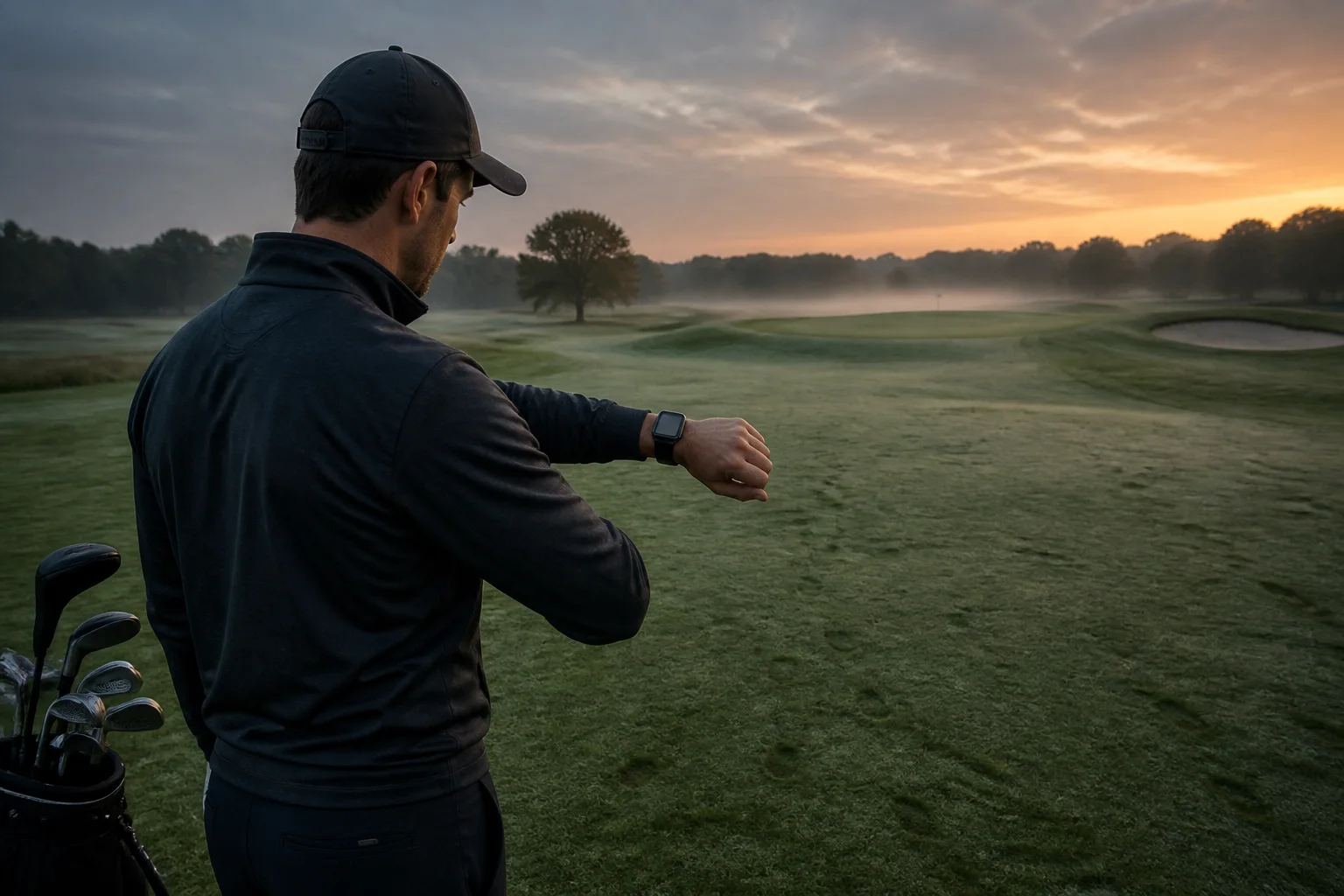
CNDR and Arccos cover the same core job: automatic shot tracking, GPS shot locations, round maps, club-distance data, recommendations and strokes-gained analysis. Arccos identifies the club through a sensor attached to every club. CNDR detects swings and putts through Apple Watch motion models and GPS, without a separate club-sensor kit. For $79.99 a year, CNDR then adds something unusually large: a full course-planning system built around your own distances, dispersion and shot shape.
A golf tracker has one unforgiving test. After the round, can it reconstruct how you actually played?
CNDR and Arccos both can. They record shots on the course, preserve their locations, turn the round into a map and calculate what those shots say about your game. It would be wrong to describe Arccos as the product for tracking and CNDR as merely the product that connects other things. Tracking is a core CNDR function.
The two systems differ less in what they produce than in what they listen to.
CNDR vs Arccos at a glance
| Feature | CNDR | Arccos |
|---|---|---|
| Automatic shot tracking | Yes—Apple Watch motion detection and on-device models | Yes—sensor on each club, detected by phone, Apple Watch or Arccos hardware |
| Putt detection | Yes—dedicated Apple Watch motion pipeline | Yes—putter sensor and tracking system |
| GPS shot locations | Yes | Yes |
| Round maps and replay | Yes—hole-by-hole shot maps and animated round replay | Yes—shots overlaid on the course map |
| Club distances | Yes—recorded and learned from tracked shots | Yes—Smart Club Distances |
| Strokes gained | Yes—off the tee, approach, around the green and putting | Yes—personal strokes-gained analytics |
| Club recommendations | Yes—on-watch recommendations using distance and club data | Yes—AI Strategy and smart club data |
| Full-course planning | Yes—automatic and manual hole plans using personal dispersion, terrain, hazards and expected strokes | On-course AI Strategy, targets and recommendations |
| Dispersion-aware targets | Yes—shot-shape bias, dispersion overlays, landing width and penalty-risk evaluation | Yes—strategy informed by personal shot and club data |
| Practice swing analysis | Yes—Apple Watch motion data for path, plane, tempo and impact metrics | Not a primary Arccos feature |
| Friends and ranked play | Yes—challenges, leaderboards and Elo-style ranking | Not the center of the product |
| Required hardware | Apple Watch; no sensor attached to each club | Smart Sensor on every club for club-level tracking |
| Availability | Early access | Established product |
| Published US price* | $79.99/year | $249.99 sensor set with first year included; then $199.99/year |
*Pricing checked August 20, 2026. Offers and regional prices can change.
Same destination, different sensors
Arccos puts a small sensor in the end of each club. Each sensor has an identity. When it detects impact, the tracking device knows both that a shot happened and which club caused it. GPS supplies the location. This is a sensible, mature design.
CNDR uses the sensors already on the golfer’s wrist. Its Apple Watch pipeline separates real swings from practice swings, detects putts, records the event time and refines the shot’s GPS location. The selected or recommended club is stored with the shot. The round can then be replayed hole by hole, with clubs, positions, putts and penalties attached.
In other words, CNDR is not a scorecard with some watch features. It is an automatic shot-tracking system whose sensor is the watch.
Arccos asks you to instrument the bag. CNDR asks you to wear the watch you may already own.
The Arccos approach has a direct advantage: because every club has its own transmitter, club identification is inherent in the hardware. CNDR’s advantage is that there is nothing to screw into fourteen grips, pair, replace or move when the bag changes.
CNDR does not begin on the first tee
Tracking tells you what happened. Planning tries to improve what happens next.
CNDR can generate a caddie plan for an entire course before the round. This is not a generic instruction to “avoid the bunker.” The planner starts with the golfer: every mapped club and its carry distance, driver dispersion, tee-shot shape and approach-shot shape.
It then reads the hole. Fairway, rough, deep rough, bunkers, water, green, the playable corridor and the width available around a landing point all enter the calculation. CNDR lays the golfer’s dispersion pattern over candidate targets, prices the misses and searches for the route with the lowest expected score.
The result is a shot-by-shot plan: club, target, expected landing area, distance travelled, distance remaining and expected strokes. Par threes, fours and fives have their own planning logic. A golfer can inspect a normal route and an aggressive alternative, move targets manually, change clubs, see the dispersion boundary and penalty-risk percentage, and save the finished course plan.
That matters in an Arccos comparison because it changes the scope of the product. Arccos offers AI Strategy and real-time recommendations based on its tracked data. CNDR also makes club and target recommendations, but its planning system is a dedicated pre-round workspace as well as an on-course aid.
Your club distances, driver dispersion, tee-shot shape and approach-shot shape.
Mapped playing surfaces, hazards, green, hole corridor, landing width and neighbouring trouble.
Expected-strokes optimization across clubs, aim lines and the realistic distribution of misses.
Automatic plans, manual targets, club changes, normal and aggressive routes, visual dispersion and saved playbooks.
After the round, both systems answer the same hard question
A list of fairways and greens is not analysis. The real question is how many strokes each part of the game costs relative to a useful benchmark.
Both Arccos and CNDR use strokes gained to separate performance into off-the-tee, approach, around-the-green and putting. Both build club distances from shot history. Both let the golfer inspect where shots finished rather than relying on memory.
CNDR also turns shot history into dispersion views for tee shots and distance-banded approaches. That same player data can feed the planner. The round is not only a report; it becomes an input to the next decision.
The Apple Watch motion record adds another layer. CNDR can associate wrist-derived motion metrics with shots and practice sessions: path, plane, tempo and impact-related measurements. Arccos is deliberately centered on what the ball and club did on the course. CNDR is designed to connect that result to the motion that produced it.
Which should you choose?
Choose Arccos if
- You want a mature, widely used system available now.
- You prefer dedicated hardware that identifies each club automatically.
- You are comfortable putting a sensor on every club and paying the ongoing membership.
Choose CNDR if
- You want the same core automatic tracking, GPS, club-distance and strokes-gained workflow without club tags.
- You already use Apple Watch and want it to power both rounds and practice.
- You want a full dispersion-aware course planner, not only a post-round tracker.
- You want swing-motion analysis, saved playbooks, friends, challenges and ranked competition in the same system.
- You are comfortable joining a product in early access.
The simple answer is this: Arccos is the established sensor system. CNDR is the Apple Watch-native tracking and planning system. Neither description requires pretending CNDR does less tracking. It does not.
Questions golfers ask
Does CNDR have the same core golf tracking functionality as Arccos?
Yes. Both automatically record shots and GPS positions, map the round, learn club distances, recommend clubs and calculate strokes gained across the four main parts of the game. Their sensing methods differ: Arccos uses a tagged club; CNDR uses Apple Watch motion detection and GPS.
Does CNDR require a sensor on every club?
No. CNDR does not require a separate sensor attached to each grip. Apple Watch provides the motion signal, while GPS supplies shot location. Clubs can be selected or recommended within the watch workflow and stored with the shot.
Can CNDR plan a complete round?
Yes. CNDR can generate and save a hole-by-hole plan for the full course. It uses the golfer’s club distances, dispersion and shot shape together with mapped terrain, hazards, playable landing space and expected strokes. Golfers can also edit targets and clubs manually.
Does CNDR calculate strokes gained?
Yes. CNDR calculates strokes gained for off-the-tee, approach, around-the-green and putting performance, and supports comparison against a target handicap.
What is Arccos’s main advantage?
Maturity and direct club identification. Its sensor knows which club produced the shot, and the product has an established hardware ecosystem and a very large historical shot dataset.
What is CNDR’s main advantage?
Breadth without a club-sensor kit. Automatic tracking, planning, practice motion, analytics and competition all use the same Apple Watch-centered performance record.
How much does CNDR cost?
CNDR costs $79.99 per year.
Editorial disclosure. CNDR publishes this comparison. Competitor facts link to Arccos’s own product and support pages. CNDR claims are based on the current app implementation, not a hypothetical feature list. Arccos is a trademark of its owner and is not affiliated with CNDR.
Sources
- Arccos Golf Game Tracking App — automatic tracking, GPS, club distances, strokes gained and AI Strategy.
- Arccos Smart Sensors — required hardware, Apple Watch compatibility and current published price.
- How Arccos works — impact detection, club identification and GPS recording.