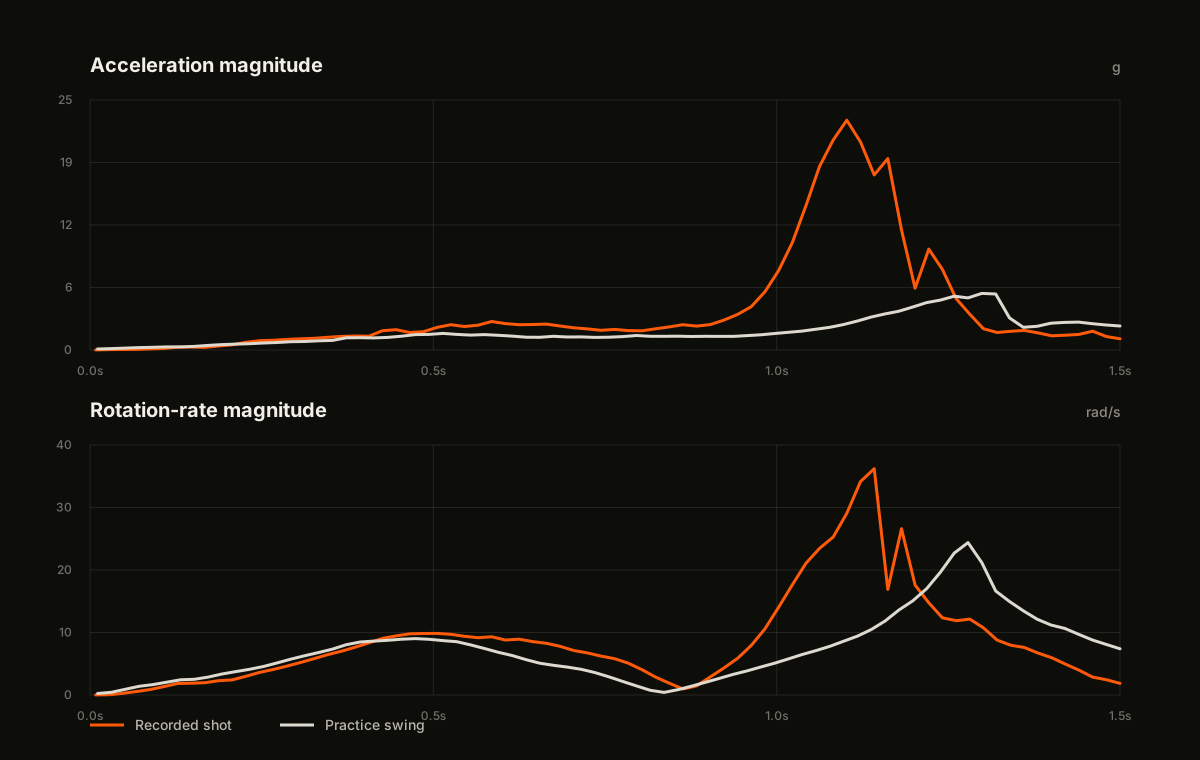
To a watch, a golf swing is about 1.5 seconds of acceleration and rotation, with the most violent part packed into a few tenths of a second. In this pair, the shot reached about 23 g and the practice swing about 5.7 g. That gap helps, but it is not a rule, which is why detecting shots takes more than one threshold.
The two traces are quiet at first. Rotation rises during the backswing, changes shape through the transition, then accelerates into a narrow, complicated peak. By the time that peak is obvious, most of the swing is already over.
Direction disappears when magnitude is plotted
The chart combines 3 axes into 1 value. That makes the overall intensity easy to read, but it hides direction. A positive turn and a negative turn can produce the same magnitude. Wrist orientation, handedness and which wrist carries the watch also change how the original axes look.
This is why a single threshold is a poor description of a swing. "Movement above X" can find energetic moments, but it cannot explain what produced them.
The shot is louder, in this pair
In this recording, the shot reaches about 23 g of acceleration. The practice swing peaks near 5.7 g. Their rotation peaks are closer: roughly 36 and 24 radians per second.
These are 2 samples from 1 small collection, not a study and not a claim about every golfer. A hard practice swing can exceed a soft shot. A chip can be quieter than both. Watch fit and sampling conditions matter.
Impact is a region, not a timestamp
The watch is on the wrist, not on the ball or the clubface. Its largest acceleration and its largest rotation do not happen at the same sample. In the recorded shot they are about 40 milliseconds apart. Calling either point "impact" would claim a precision that the sensor does not have.
A more honest reading is that both belong to an impact region: the short part of the motion where the downswing, the strike and the early release overlap in the wrist signal.
The difficult question comes afterward
Recognising that something swing-shaped happened is only the first problem. The harder question is whether it belongs in the round. Practice swings are similar to shots on purpose. Walking, moving a bag, riding in a cart or reaching for a club can create fragments that look like part of the trace.
Motion needs context: what happened just before and after, whether a round is active, where the player is on the hole, and whether another shot would make physical sense there.
The watch sees the wrist. The rest of the system has to work out the golf.
Questions from golfers
Can a watch tell a practice swing from a shot?
Not from motion alone in every case. A real shot is often louder, but a hard practice swing can exceed a soft shot. CNDR also uses context, such as where you are on the hole and what happened before and after the swing.
Why not use one acceleration threshold?
Because energy is not the same as a golf shot. A threshold finds energetic moments, but it cannot tell a swing from walking, lifting a bag or a practice swing.
When exactly is impact in the signal?
The watch cannot mark it to the millisecond. Peak acceleration and peak rotation are about 40 milliseconds apart in this shot, so impact is best read as a short region.
Method. The source files contain 76 and 75 samples over approximately 1.5 seconds, at roughly 50 Hz. Acceleration magnitude is √(x² + y² + z²) of Core Motion user acceleration in g. Rotation-rate magnitude uses the same calculation in radians per second. The chart comes directly from the recorded files, with no smoothing.
This article comes from ongoing work on motion detection in CNDR. It is published to make the assumptions and limits visible, not to present 2 swings as a finished dataset.
Sources
- CNDR motion recordings: 1 recorded shot and 1 practice swing on Apple Watch, Core Motion user acceleration and rotation rate.
- Apple, Core Motion documentation: CMDeviceMotion user acceleration and rotation rate.